
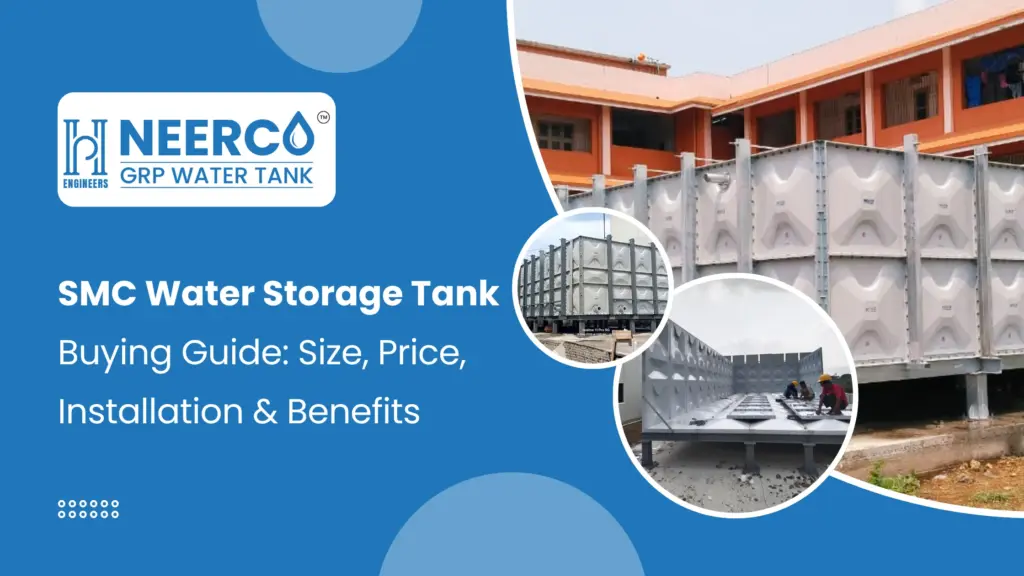
What Is an SMC Water Storage Tank?
An SMC panel tank consists of glass-fiber-reinforced thermosetting resin panels assembled on-site through bolted connections. These modular systems accommodate rooftop, underground and ground-level placements. Manufacturing adheres to international benchmarks including BS EN 13280 and ISO 9001 certification standards.
Why Choose SMC Rooftop Installation?
Elevated positioning leverages gravity-fed distribution while minimizing pump reliance and operational expense. Key advantages include:
- Lightweight panels enabling simple transport and rooftop hoisting
- Modular assembly without welding prerequisites
- Corrosion-resistant construction preventing rust and contamination
- UV-resistant exterior withstanding direct sunlight
- Seismic-rated options for earthquake-prone regions
SMC tanks are food-grade certified without requiring internal protective linings, representing significant cost and upkeep savings.
SMC Panel Tank Sizes: What to Choose?
| Capacity | Dimensions | Application |
|---|---|---|
| 1,000-5,000 L | 1m × 1m base | Residential rooftops |
| 5,000-20,000 L | 2m × 2m to 3m × 2m | Commercial buildings |
| 20,000-100,000 L | 4m × 4m and above | Industrial / hospital complexes |
| 100,000 L+ | Custom modular | Large plants, municipalities |
Panel thickness typically spans 8mm to 15mm, with larger tanks requiring thicker panels for enhanced pressure capacity.
SMC Panel Tank Price in India
Pricing varies with insulation, fittings, access points and professional installation. Representative ranges:
- Small tanks (1,000-5,000 L): ₹15,000 – ₹40,000
- Medium tanks (10,000-50,000 L): ₹60,000 – ₹2,50,000
- Large tanks (1,00,000 L+): ₹3,00,000 and above (custom quotation)
Rooftop Installation: Step-by-Step
Step 1 – Structural Assessment
Verify rooftop capacity with a structural engineer. A 10,000-litre tank exerts approximately 10 tonnes of load.
Step 2 – Base Frame & Anti-Vibration Pads
Install galvanised or stainless steel support frames with isolators on perfectly level surfaces.
Step 3 – Panel Assembly
Bolt SMC panels using EPDM rubber seals and stainless steel hardware per manufacturer torque specs.
Step 4 – Inlet, Outlet & Overflow Connections
Connect supply valves, distribution outlets, overflow pipes and drain valves using food-grade materials.
Step 5 – Pressure & Leak Testing
Fill the tank and hold water for 24 hours, inspecting all joints and connections for leaks.
Step 6 – Access & Safety
Install lockable manhole covers, internal ladders where required, and insulating covers for temperature extremes.
Key Benefits for Industrial Buyers
| Benefit | Impact |
|---|---|
| 25-30 year lifespan | Reduced lifecycle expense vs steel |
| Hygienic food-grade material | WHO and BIS-compliant storage |
| Modular design | Expand capacity without full replacement |
| Low maintenance | No painting, lining or recoating |
| Fast installation | On-site assembly in 1-3 days |
Technical Considerations Before Buying
- Panel grade with higher resin content (≥30% glass fibre) for durability
- Hot-dip galvanised steel or SS304 frames for rooftop environments
- Foam-injected double-layer panels for temperature-sensitive climates
- Compliance: BS EN 13280, NSF/ANSI 61 or IS 12701
- Industry-standard warranties from 10 to 25 years
Maintenance Tips to Maximise Tank Life
- Conduct annual inspections of panel joints, bolts and seals
- Perform 6-monthly interior drainage, rinsing and disinfection
- Check inlet filters to prevent sediment accumulation
- Inspect support frames for post-monsoon corrosion
- Run quarterly microbiological water-quality assessments
Why SMC Is Replacing Traditional Tanks
Modular GRP/SMC systems are supplanting concrete and galvanised alternatives due to faster project completion, lower total ownership cost, alignment with water-hygiene requirements and simplified capacity scaling. For a head-to-head, read SMC Panel Tank vs Overhead Tank vs RCC Tank.
Conclusion
SMC water storage tank selection is a fundamental infrastructure decision affecting water quality, performance and maintenance. With a 25-30 year lifespan and compliance with BS EN 13280 and IS 12701, these systems compare favorably against RCC and metal counterparts. Careful load assessment, sizing, quality panel selection and certified installation ensure the best outcome — get a free sizing quote from HP Engineers.